Enriching and Futureproofing the Databases of the Hungarian Heritage House
A short feasibility study and early manuscript for publication (version 0.2.0)
Antal, Dániel 
Zagyva, Natália
Mester, Anna Márta
Introduction
This document serves as a living document for documenting the Reprex-HH documentation to serve as a basis of the forthcoming joint publication.
This is the version 0.2.0 and it has not been reviewed by Hagyomanyok Háza institutionally, it may contain mispresentation of some HH databases.
DOI: 10.5281/zenodo.17759777; please check for potential later versions before re-using or citing.
Folklore Databases in Hungary
Folklore databases in Hungary play a crucial role in preserving, systematising, and rendering accessible the country’s intangible cultural heritage. The most significant collections and datasets are maintained by leading scientific and cultural institutions that have long served as custodians of ethnographic and musicological knowledge.
The Ethnological Archives of the Museum of Ethnography function as the central archival repository of Hungarian ethnography. They hold an extensive corpus of manuscripts, photographs, films, and sound recordings, much of it originating from a nationwide network of community collectors who contributed materials through organised collecting schemes. Through sustained digitisation efforts, the Museum has made a substantial portion of these holdings available as online collections and thematic digital resources. These resources constitute an irreplaceable foundation for contemporary folkloristic research.
The archives of the Institute of Ethnology and the Institute for Musicology primarily preserve materials accumulated through fieldwork conducted by researchers, along with records arising from archival investigations. They also safeguard the personal papers, manuscripts, and legacies of scholars, folklorists, and composers. Over the past decades, these institutes have developed a number of highly valuable thematic folklore databases, covering the domains of folk music, folk dance, and narrative folklore.
A fourth institution of major importance is the Heritage House (Hungarian Heritage House) in Budapest, founded in 2001. Its folklore collections and ongoing development projects are discussed in detail in the following chapter.
For piloting, we chose to work with two data sources.
500 Folk Music Examples from Székelyföld: One of the processed collections derives from ethnomusicologist István Pávai’s representative selection of folk music from Székelyföld (Szeklerland in Romania.) The examples are organised according to a regional classification system developed by Pávai, based on his field research and tailored to the stylistic and geographical distribution of traditional dance music.
The metadata accompanying the sound recordings include: place of use (macro-region, region, micro-region, settlement); genre; informant (name, age or year of birth); performance mode (instrumentation); date of collection; collector.
The recordings originate from 101 settlements across Székelyföld.
Folk Tale Inventory: The second collection is currently unpublished. In 2003–2004, Sára Dala and her colleagues compiled a dataset containing more than 11,000 Hungarian folk tales, intended to serve as the foundation for an online catalogue arranged by geographical area and chronology, supporting the work of researchers, educators, cultural mediators, and storytellers.
Under the working title Folk Tale Inventory, the compilers processed the contents of 467 printed volumes. In addition to bibliographic data, the dataset includes the place of use (settlement, county), the informant, the collector, the date of collection, and the tale type. The editors intend to expand the dataset with materials published after 2000, as well as tales available in audio and video formats.
Within the present project, we restrict our work to the material published in 1957 as Háromszék Hungarian Folk Poetry (Háromszéki magyar népköltészet), documenting the collections of Samu Konsza and his students in the Háromszék region. This subset comprises 121 folk tales from 39 Székelyföld settlements.
We chose this collection to show that gradually we can extend our immaterial work model optimised for music to other related immaterial heritage. The transition from musical works to folk tales is natural, because the tales are often preserved as sound recordings, and they have similar textual manifestations as the lyrics of vocal music.
Our aim is to follow the European Interoperability Framework1, and to utilise our work developed in the OpenMusE project, particularly with the creation of the architecture of the Open Music Observatory, and the experience gained with its Finno-Ugric federated module. we aim to create not only technically and semantically correct new representations of the databases of Hagyományok Háza (in short: HH) but also workflows (organisational aspect) and data governance (legal aspect) of our work.
In our work, we aim to transfer some of the databases, or their data tables as datasets into a graph format. Particularly suitable data for this task is the person, corporate and geographical name spaces, which need to be permanently updated, and often enriched for further historical or other language variants. Another trivial choice is the representation of a thesaurus in this format, as thesauri per se follow a graph format. Last, but not least, the graph format can help to connect relational databases that are now standing alone, or to re-document and improve the metadata schemas of existing relational databases or their tables.
Linking datasets across domains, institutions, and languages proved more difficult and less successful than the 5-star FAIR model suggests. In practice, findability, interoperability, and reuse are not easily achieved across national metadata practices, multilingual vocabularies, or heritage-specific contexts. For this reason, we adopted the extended 8-star model of linked cultural data proposed by Hyvönen and Tuominen (Hyvönen and Tuominen 2024), which adds essential dimensions such as provenance, multilingualism, contextualization, participation, and sustainability. This higher standard better reflects the realities of cross-border, community-anchored heritage work and connected unconnected, often less documented databases, Excel sheets, and different information sources.
Architectural choices
The architectural choices for connecting Hungarian music and folklore datasets to a future-proof, interoperable infrastructure must address three simultaneous challenges:
(1) historically layered and multilingual heritage;
(2) highly heterogeneous and partly undocumented legacy databases; and
(3) limited institutional capacity for large-scale ontology engineering.
For these reasons, we have focused on Wikibase as the core bridging technology. Its suitability is demonstrated most clearly by the National Library of Wales’ SNARC (Shared National Archival Record Catalogue) architecture, which has already been adopted as a model by cultural-heritage institutions across Europe. SNARC is a directly relevant precedent for HH, because it supports exactly the combination of requirements present in Hungary: distributed collections, multilingual metadata, legacy databases, and active community contributors.
Wikibase has proven effective for multilingual authority control (Bianchini, Bargioni, and Pellizzari di San Girolamo 2021; Fagerving 2023). The Finnish Wikibase pilot of the National Library of Finland demonstrated how it can connect museum, linguistic, and archival records while also supporting community participation (National Library of Finland 2021). Similar experiences in minority-language contexts—such as the Võro User Group (Wikimedians of Võro language User Group 2025) and Wikimedia Norge’s Sámi knowledge project (Wikimedia Norge 2020)—show that Wikibase can combine semantic interoperability with respect for knowledge sovereignty and multilingual representation. These experiences are particularly suitable for connecting to less formal civic or community, municipal diaspora Hungarian collections. These precedents confirm that Wikibase can act as a shared, multilingual curatorial platform for minority and diasporic heritage without imposing a single institutional metadata regime.
The relevance of the Welsh precedent is explicitly confirmed in the documents the National Library has made public and is also reflected in the wider scholarly literature, and given the institutional strength of the Welsh National Library, it is probably the highest scaled subnational example. As summarised in our internal materials:
“A notable example is the SNARC Wikibase… developed by the National Library of Wales. SNARC allows Welsh libraries, archives, and museums to describe cultural heritage using persistent identifiers and structured metadata in Welsh and English. It supports shared authority work and multilingual reconciliation while respecting institutional diversity and community input.”
This architecture provides not only a technical blueprint but also a governance model that suits a heritage ecosystem with many semi-independent contributors, including fieldworkers, regional archives, civic initiatives, and diasporic communities.
Wikibase offers an effective bridge between human-centred curatorial workflows and the formal structures of the semantic web. As an open, collaborative platform, it enables curators, researchers, and community partners to describe heritage materials in a readable, intuitive format, while simultaneously maintaining machine-actionable semantics through RDF export. This duality makes Wikibase particularly suitable for projects that must combine community participation, multilingual metadata, and interoperability with formal ontologies such as HDTO (ECCCH), CIDOC-CRM (museums), Records in Contexts (archives), and DCTERMS)2.
In contexts characterised by limited archival depth, legacy databases of uneven quality, or undocumented local schema variations, strict ontology-based systems can easily become too rigid for practical curation. Wikibase, by contrast, supports incremental enrichment. Incomplete, contradictory, or uncertain statements can coexist with qualified assertions, references, and provenance notes. Curators can therefore record uncertainty—an intrinsic part of folkloristic and ethnographic data—without compromising the coherence of the underlying semantic structures.
Its flexible data model also allows domain ontologies to be introduced progressively: digital-twin classes, heritage-entity relations, component hierarchies, and temporal layers can be added over time without disrupting existing documentation practices. This progressive modelling principle is essential for a project like HH, where archival quality, provenance depth, and historical metadata formats vary significantly across collections.
The Welsh Model: Why SNARC Is the Most Relevant Precedent
SNARC demonstrates how Wikibase can operate as a national-level authority and reconciliation layer for distributed archives. Its architecture exhibits several properties that map directly onto the needs of Hungarian folklore collections:
Multilingual authority control with community participation: SNARC maintains bilingual (Welsh/English) labels, descriptions, and authority records, enabling minority and regional languages to coexist with national cataloguing standards. This aligns with HH’s need to support Hungarian, regional dialects, and minority languages across the Carpathian Basin.
A federated approach rather than centralisation: Institutions retain autonomy over their internal databases, while contributing shared authority data into the Wikibase layer. This mirrors the governance model recommended we followed with the prototyping in the Finno-Ugric Data Sharing Space, and fits in with the situation in Hungary: HH must integrate data from diverse field researchers, local cultural centres, and legacy scholarly collections without imposing a single catalogue.
Support for weakly standardised, legacy, and community-derived data: SNARC deals with inconsistent archival metadata, variant place names, historical spellings, and ambiguous provenance—challenges identical to those found in Hungarian folklore collections.
A sustainable governance model: Wikibase enables contributors, stewards, validators, and reviewers to participate according to their role. This matches HH’s needs: ethnomusicologists, dance researchers, ethnographers, and community collectors can contribute in different capacities.
Compatibility with semantic-web export: SNARC relies on Wikibase’s RDF layer to integrate with external linked-data infrastructures—analogous to our plan to export to HDTO/ECCCH and other European data spaces.
Wikibase as a Bridging Layer in Heritage Architectures
Architecturally, Wikibase functions as a bridging layer between descriptive archives (AtoM, legacy field-record tables, digitised notebooks, manuscript metadata) and semantic infrastructures capable of supporting cross-institutional reasoning. It links curatorial work with graph-based analytics through:
Federated SPARQL queries
Multilingual labels and aliases
Reconciliation services
Versioned, provenance-rich authority records
Incremental modelling of heritage ontologies
This architecture has been tested extensively in the Finno-Ugric Data Sharing Space, where it supports the representation of complex, multilingual, and historically layered heritage in a transparent, sustainable form. Human curators maintain an accessible knowledge base; automated pipelines generate HDTO-compliant linked-data exports for long-term interoperability.
For the HH pilot, we will therefore:
Use the existing, well-curated Finno-Ugric Wikibase instance to test small sample datasets.
Evaluate feasibility and governance requirements for establishing one or two dedicated Wikibase instances:
– a public-facing authority and catalogue layer,
– and, if necessary, a more detailed internal-facing instance for sensitive or partially processed data.This staged approach mirrors the Welsh model, where the public Wikibase instance aggregates reconciled data, while institutions retain internal systems tailored to their operational needs.
Subsidiarity in Data Governance: Proven Suitability for Minority, Regional, and Diasporic Heritage
The suitability of Wikibase for complex cultural ecosystems is supported by comparative examples:
– the National Library of Finland’s Wikibase pilot,
– the Võro User Group’s regional-language knowledge base,
– Wikimedia Norge’s Sámi metadata projects,
– and other community-based knowledge initiatives.
These projects demonstrate that Wikibase can combine semantic interoperability with knowledge sovereignty, a crucial requirement for representing the diverse, often community-generated folklore and folk-music heritage that HH oversees.
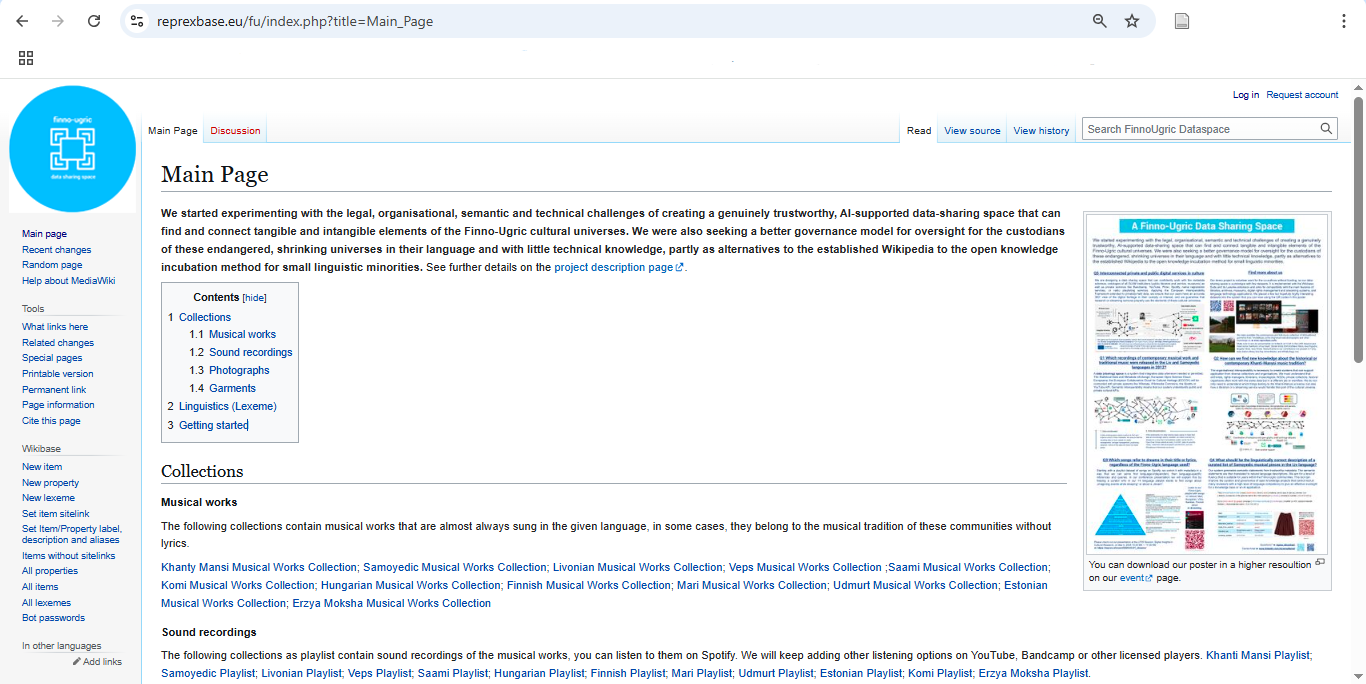
Within the Finno-Ugric Data Sharing Space, this approach allows complex, multilingual, and historically layered heritage to be represented transparently and sustainably: human curators maintain an accessible knowledge base, while automated exports produce HDTO-compliant datasets for long-term interoperability. We will test this well-developed and curated Wikibase instance for the first phase of testing small data samples from HH, then we review the feasibility of building one or two dedciated (for example, public facing and separate internal facing) instances for HH.
Alignment with European Research Infrastructures
Reprex aligns the Wikibase data model with the Heritage Digital Twin Ontology(HDTO), the semantic backbone of the European Collaborative Cloud for Cultural Heritage (ECCCH). This alignment ensures that HH’s data will be future-proof, interoperable with European heritage clouds, and ready for integration into AI-assisted digital humanities tools.
In this respect, Wikibase functions not merely as a curatorial interface, but as an enabling architecture for open, interoperable cultural-heritage data within the emerging European research and data-space ecosystem.
Viability and competences
Because Reprex works with very similar data from the Latvian Folk Archive, and various smaller Nordic and Baltic collections, and Hungarian and Slovak repertoire data, we are importing into the current datasets a small subset of Folk Tales Inventory [Népmeseleltár], in short: FTI Example Dataset, and the A Székelyföld népi tánczene szempontú táji tagolódása – 500 hangzó példa, in short, Szekler dance music dataset created by Pávai, István to demonstrate on a small scale the value, usability and problems of the broader collections of HH.
These datasets, as much as it is possible, will be converted and added to the Finno-Ugric Data Sharing Space (FUDSS), a non-profit, research data sharing space that connects various Finno-Ugric immaterial and material culture in formats that are interoperable with libraries, archives, museums, Europeana, Daria-H, and the European Culture Heritage Cloud.
FUDSS only stores metadata and does not take away any published HH material; it will link back to the Szekler dance music dataset. It will expose a small subset, probably ~50 tales with connected bibliographical entries from FTI Example Dataset, which is less than 0.5% of the contents of the original data source.
The aim of this direction is:
to evaluate to what extent the current data models developed by Reprex with the Latvian Folk Archive and other similar organisations can be directly applicable to HH;
to gain hands-on graph building, reviewing, editing experience to the HH team;
to expose various professional questions in the entire data curation workflow (technical, semantic, scalability or legal)
At the same time, HH colleagues will write competency questions to the expected graph, which we hope to be able to answer by querying the FUDSS in SPARQL. The competency questions should be organised like this.
A Székelyföld népi tánczene szempontú táji tagolódása – 500 hangzó példa
Competences expected from importing to the FUDSS graph:
Which example items were in use in
Gyergyóremete?Which example items were collected by
Pávai, István?What musical instruments appear in Pávai’s examples?
Which instrumental ensembles appear among Pávai’s examples?
In which example does a clarinet appear?
In which folk region is the dance called korcsos found?
What cultural micro-regions belong to the Marosszék cultural (meso)region?
From which Bartók collections (location and date of collection) did István Pávai select his examples?
After enriching the graph with Linked Open Data:
Which collector worked in
Remetea[with the addition of multi-language gazetteer], for methodology see Remapping the Livonian Coast: A Multilingual Gazetteer of the Settlements of Northern Kurzeme (Antal, Pigozne, and Mester 2025).Which example items were collected within 25 kms from
46°15'8.96"N, 25°26'5.86"E. We enriched Abásfalva-Aldea with geographical coordianates and Geonames PID (686517); a simple distance function can be built in a query that answers this question and lists other collection locations that fall into the radius.Which publications of the collector Agócs, Gergely are available in OSZK and other libraries?
Which settlements in the collection have a proportion of Hungarian population below 50% according to the 2021 Romanian census?
After feasibility accomplished:
Which publications of the collector
Bartók, Bélaare available in library of HHWhich original audio tapes on inventory are connected to the collector
Pávai, IstvánWhich collection can be listened to in its entirety in the Folklore Database (Folklóradatbázis)?
Which original media can be listened to in its entirety in the ZTI Sound Archive?
Folk Tales Inventory [Népmeseleltár]
We placed about 120 folk tales from Transylvania into our database. These entries are not the abstract tales, but their textual manifestations as they were described in Konsza, Samu: Háromszéki magyar népköltészet [Folk Poetry of Háromszék] and made available originally by the State Publishing House for Literature and Arts / Állami Irodalmi és Művészeti Kiadó, and currently by Adatbank (fudss:Q5823)].
We used the following modelling solutions:
- We placed Competences expected from importing to the FUDSS graph:
Which tales were published in Magyar Nyelvőr in the year 1888?
Which tales were collected in Mohács?
Which tales were collected by Ortutay, Gyula?
After enriching the graph with Linked Open Data:
Which collector worked in Берегуйфалу [requires addition of multi-language gazetteer]
Which example items were collected within 25 kms from 48°16’36”N, 22°48’28”E
Which publications of the collector [Ortutay, Gyula] are available in OSZK?
What did Samu Konsza look like?
Where was Samu Konsza born and where did he die?
After feasibility accomplished:
Which publications of the collector [Ortutay, Gyula] are available in library the of HH?
Which original fieldnote documents are connected to the collector Ortutay, Gyula?
AtoM integration and round-trip validation
Hagyományok Háza (HH) aims to migrate its archival descriptions into the Access to Memory (AtoM) system. To ensure that the proposed semantic-web workflow remains compatible with archival practice, the pilot includes a round-trip interoperability test between AtoM and the Finno-Ugric Data Sharing Space (FUDSS). In this phase, a small number of AtoM records will be exported in standard archival formats (EAD and EAC-CPF) and imported into the FUDSS Wikibase environment. These items will be modelled using the same pragmatic linked-data patterns applied to the FTI Example Dataset and the Szekler dance music dataset. After modelling and enrichment, the records will be exported back into AtoM-compatible EAD XML for re-ingestion.
The National Library of Wales follows a comparable model in its Shared National Archival Record Catalogue (SNARC), where Wikibase operates as a reconciling and multilingual authority layer while traditional archival systems continue to provide core descriptive functions. Our test evaluates whether HH can adopt a similar architectural pattern.
Access to Memory (AtoM) is an open-source archival management system designed for day-to-day descriptive work in small and medium-sized heritage institutions. It implements the International Council on Archives’ legacy standards—primarily ISAD(G) for archival description and ISAAR-CPF for authority records—encoded in the XML format Encoded Archival Description (EAD 2002). This offers a lightweight, well-structured framework for managing fonds, series, file-level descriptions, and associated digital objects. Because AtoM uses plain EAD XML for import and export, it remains highly accessible and easy to integrate with other systems, even if it does not support graph-based representations.
Several institutions have shown that AtoM can interoperate effectively with Wikibase. While AtoM provides a practical user interface for archival workflows, Wikibase is inherently better suited for maintaining synchronised authority records, linking to national and international name spaces, and enriching collections with multilingual or contextual metadata. Wikibase also accommodates the graph structures introduced by Records in Contexts (RiC) (Archives Expert Group on Archival Description 2023), which in 2023 superseded ISAD(G), ISAAR-CPF, ISDIAH, and ISDF as the ICA’s conceptual and ontology framework.
RiC remains backwards-compatible with ISAD(G) while enabling richer semantic relations—such as connecting AtoM authority records to VIAF and national authority files, providing bibliographical or museological context to archival holdings, or linking a specialist archive like HH’s to national repositories.
In this project, we designed a lightweight, reversible pipeline between AtoM and Wikibase. AtoM exports existing descriptions in EAD XML, which are transformed and ingested into Wikibase for authority reconciliation, structural clarification, and multilingual enrichment. The enhanced records can then be exported back into simplified EAD XML suitable for AtoM. This round-trip workflow allows institutions to benefit from Wikibase’s semantic capabilities without replacing AtoM as their operational catalogue.
The most promising use cases for this workflow are:
- maintaining authority records in Wikibase, ensuring they remain synchronised with external vocabularies while AtoM receives the simplified form it can store;
- large-scale migration of older or heterogeneous databases into Wikibase for cleaning, modelling, and multilingual enrichment, followed by targeted export to EAD XML for incremental import back into AtoM.
Modelling pragmatism
Our solution is the Finno-Ugric Data Sharing Space, a lightweight, federated infrastructure that supports participatory metadata repair, semantic enrichment, and multilingual modelling. Technically, our infrastructure connects CIDOC CRM-based museum records, DCTERMS-based library metadata, and Wikibase lexemes through shared patterns, allowing heterogeneous sources to interoperate without enforcing a single monolithic schema.
Geographical Gazetteer
Place names show even greater variability than personal names, especially in multi-ethnic regions. To manage this, we constructed a multilingual geographic reconciliation layer (gazetteer) to align historical and modern toponyms.
Our initial focus was the FTI Example Dataset, covering part of Székelyföld. For example, Gyergyóremete (fudss:Q5730) has multiple culturally relevant appellations:
Gyergyóremete (fudss::Q5730)
├─ has label (en) → Remetea, alias Gyergyoremete
├─ has label (ro) → Remetea, alias Gyergyoremete
├─ has label (hu) → Gyergyóremete, alias Remetea
├─ coordinate location → 46°47’36.71”N, 25°27’1.01”E
└─ Geonames ID https://www.geonames.org/668986
We use the current official name (Remetea) for English-language systems, while retaining historical and culturally meaningful variants for multilingual discovery. ASCII-normalised aliases ensure compatibility with search interfaces lacking diacritics. Wikibase’s UI handles all these variants gracefully through its label–alias lookup.
We treat Gyergyóremete as a place appellation, reflecting a cultural concept rather than an administrative boundary. Heritage materials relate to this conceptual locality even when municipal borders shift.
For broader regions such as Háromszék, midpoint coordinates are insufficient. Boundary polygons (e.g., from OpenStreetMap) or explicit hierarchical relations are required to support reasoning about inclusion.
Our workflow follows a bottom-up strategy: starting from raw tabular values and incrementally introducing higher-level spatial hierarchies. This mirrors our Livonian Coast Gazetteer, derived from The Livonian Place Name Catalogue (Ernštreits, Šuvcāne, and Damberg 2024; Antal, Pigozne, and Mester 2025).
All reconciliation steps are documented using OpenRefine and integrated into our tutorial book.
Thesaurus and Ontology Patterns
Parallel to geographic reconciliation, we translated and graph-integrated a subset of HH’s internal thesaurus, aligning it pragmatically with the Getty Art & Architecture Thesaurus® (AAT) (Harpring et al. 2020; Silva 2022). We used a label-focused approach, retaining AAT’s upper-level conceptual structure while introducing local subclasses where appropriate.
This balances broad discoverability with ontological precision. General terms (e.g., lakodalom) serve as human-friendly entry points, while more specific concepts emerge through iterative refinement. This follows the principle of ontology seeding (Maria Teresa, Stellato, and Vindigni 2012; Maria Teresa and Stellato 2012), combining automated extraction with expert correction.
Our approach aligns with the Semantic Web “layer cake” model (Mayank, Craig A., and Pedro 2021), where vocabularies like AAT and CIDOC CRM occupy the semantic middle layer. CIDOC CRM itself functions more as a modelling dialect than as a rigid ontology (Bekiari et al. 2024), and archival metadata adds additional complexity as institutions transition from legacy standards, such as ISAD(G), to Records in Contexts (RiC) (Archives Expert Group on Archival Description 2023).
To address this heterogeneity, we emphasise modular ontological patterns rather than comprehensive global alignment. Drawing on eXtreme Design and recent work in the Polifonia Ontology Family (Blomqvist, Hammar, and Presutti 2016; Berardinis et al. 2023), we extract reusable fragments that support low-friction cross-domain linking. Rather than “ontological hijacking,” we formalise recurring vernacular patterns found in AAT, Wikidata, and community vocabularies alike.
This positions our work at the interface between general-purpose ontologies and community-specific modelling. Our aim is not to replace established standards but to complement them—enabling smaller, underrepresented knowledge systems to participate in linked-data infrastructures without flattening epistemic diversity. Governance, multilingual support, and contextual sensitivity are built into this architecture from the outset.
Folk tales
We mapped the Meseleltár to a text-manifestation class. The chapter class is well established in museum, library, and web ontologies (crm:E31_Document, frbroo:F24_Publication_Expression, schema:Chapter):
chapter
├─ book section (unnumbered) (fudss::Q5818)
└─ folk tale textual manifestation (fudss:Q5819)
Example:
The Wolf, the Bear and the Hussar (folk tale manifestation) → https://reprexbase.eu/fu/Item:Q5820
The corresponding abstract work is modelled as a subclass of literary work without individual authorship. Later iterations will connect abstract tales to international taxonomies (e.g., ATU types), enabling linkage of textual manifestations, audio recordings, and fieldwork variants.
The Wolf, the Bear and the Hussar (folk tale) ([fudss::Q5820])
└─ has taxonomical entry → ATU type
└─ has manifestation → folk tale text manifestation ([fudss::Q5826])
└─ is curated member of → Meseleltár
└─ published in → Háromszéki magyar népköltészet ([fudss:Q5815])
└─ is heritage of → Székelys
The property is heritage of derives from the Heritage Digital Twin Ontology (HDTO), supporting connections to legal and policy frameworks such as Hungaricum registries or national cultural-content classifications.
Meseleltár ([fudss:Q5825])
└─ instance of → collection
The is curated member of relationship provides transparent curatorial provenance. New tales can be added; erroneous entries can be corrected or removed. The publication node (Háromszéki magyar népköltészet) is treated as a standard book object and can be linked to external library systems.
For usability, we attach has access point directly both to the publication node and to individual tale manifestations so that Sampo-UI displays a direct download link for each item, even though this introduces a small amount of formal redundancy.
Ethical and legal considerations
Alongside FAIR and the 8-star model, we also considered the CARE Principles for Indigenous Data Governance (Collective Benefit, Authority to Control, Responsibility, Ethics) (Carroll et al. 2020). While these principles were formulated in Indigenous contexts such as North America and Oceania, they offer relevant guidance for Finno-Ugric heritage. The situation of these communities is heterogeneous: Hungarians, Finns, and Estonians are nation-states with strong institutional infrastructures; Seto, Võro, Csángó or Szekler communities are integrated minorities with various level of community rights, formal and informal organisations, and ability to use their languages. Our DSS adapts CARE to this environment by prioritizing multilingual metadata accessibility, cultural reassembly, and safe avenues for community review, while acknowledging that not all CARE provisions can be applied in the same way.
Rights management within the FinFAIR framework is designed to be transparent, interoperable, and machine-readable.
It combines the Heritage Digital Twin Ontology (HDTO) with practical extensions in Wikibase that allow curators to express not only licences but also contextual usage rules derived from the Open Digital Rights Language (ODRL).
While large digital-heritage platforms such as Europeana or DARIAH rely mainly on single-URI licence models (edm:rights, dcterms:license), FinFAIR adds an optional layer of structured use policies to handle complex, multimodal works such as music or film, where overlapping rights coexist.
Personal Data and GDPR
Every hdt:HC1_HeritageEntity or hdt:HC2_HeritageDigitalTwin may link to living agents—performers, collectors, researchers, donors, or other data subjects—through dcterms:creator, prov:wasAttributedTo, or crm:P14_carried_out_by.
Under the General Data Protection Regulation (GDPR), these names constitute personal data.
Before publication or linkage, consent and attribution are evaluated:
- Attribution — if the person consents to credit, we use
cc:attributionName. - Pseudonymisation — if consent is uncertain, we use neutral labels, e.g. “Field recording performer, 1962”.
- Anonymity — if the person requests privacy, all identifying information is withheld.
- The selected attribution mode determines the applicable licence.
For example, CC-BY assumes credit, while pseudonymised or anonymous materials default to CC0, BY-NC, or a corresponding rightsstatements.org URI.
For older archival materials, FinFAIR follows Europeana’s approach: if the data subjects are certainly deceased (typically pre-1925), personal-data restrictions no longer apply.
Simple Case: One Licence per File
For non-composite objects—photographs, scans, or plain-text documents—the Europeana Data Model (EDM) edm:rights field provides sufficient legal clarity.
FinFAIR implements this directly via the Wikibase property use rights, which corresponds to dcterms:license and edm:rights.
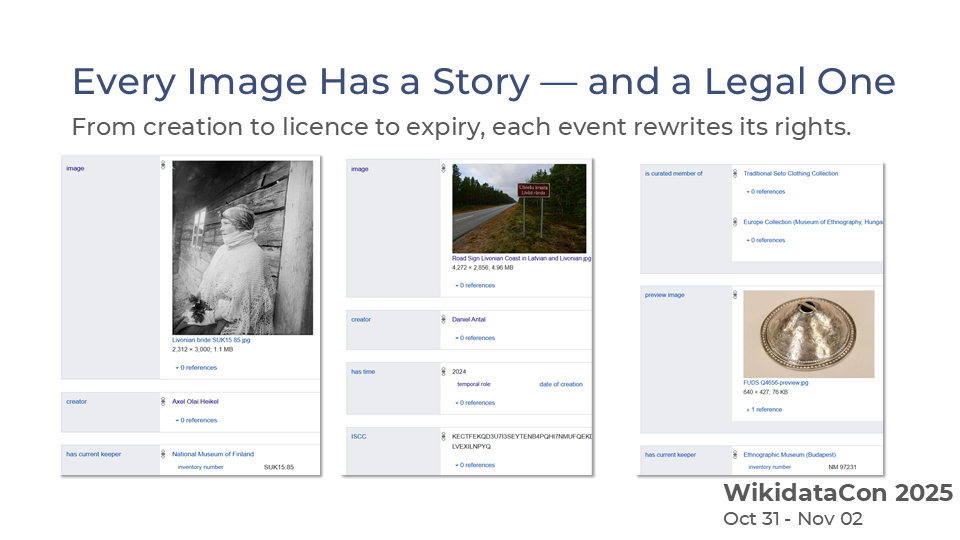
Even these “simple” cases are dynamic. A copyright protection term may expire, making a less accessible item fully reusable under the public domain. Rightsholders may change their minds, and give a more permissive license, for example, change from CC BY-NC-ND to CC-BY-SA, allowing commercial use and derivate works.
| Type of object | HDTO class | Typical examples |
|---|---|---|
| Digital text | hdt:HC6_DigitalDocument |
metadata exports, lyrics, PDFs |
| Digital image | hdt:HC7_DigitalVisualObject |
photographs, scans, blueprints |
| Simple audio file | hdt:HC5_DigitalRepresentation |
single, unambiguous recordings |
Each digital component carries:
- use rights → a URI pointing to a standard licence (e.g. CC-BY, CC0);
- optional provenance (dcterms:rightsHolder, dcterms:accessRights, dcterms:provenance).
The composite digital twin (HC2) aggregates multiple components but does not override their licences.
When reused, the most restrictive licence among components applies.
Wikibase Rights Extensions
To align HDTO, EDM, and Wikibase, FinFAIR defines two complementary properties and one supporting class.
All examples below will be changed this week to HH examples for discussion.
Property: use rights (wd:P486)
| Field | Description |
|---|---|
| Label | use rights |
| Description | Links a digital object to a URI identifying the applicable licence or rights statement (e.g. rightsstatements.org, Creative Commons). |
| Aliases | licence; rights; edm:rights; dcmi:license; datacite:rights |
| Datatype | External identifier (URI) |
| Equivalent properties | dcterms:license, edm:rights, datacite:rights |
| Full definition | https://reprexbase.eu/fu/Special:EntityData/P486.ttl |
Example:
Dēliņi homestead detail: combined barn-shed (detail photo)
use rights: https://creativecommons.org/licenses/by-sa/4.0/deed.enThe Livonian Community House in Mazirbe (photograph)
use rights: https://creativecommons.org/licenses/by/4.0/deed.en
This property provides one-to-one interoperability with both Europeana and research repositories using DataCite
Property: use policy (wd:P487)
| Field | Description |
|---|---|
| Label | use policy |
| Description | Links a digital object to a local rights or usage policy item within the same Wikibase instance (e.g. “Listen on Spotify”). Used when the applicable terms are described internally rather than via an external URI. |
| Aliases | has policy; user rights policy |
| Datatype | Wikibase item |
| (Near) Equivalent class | odrl:Policy |
| Full definition | https://reprexbase.eu/fu/Special:EntityData/P487.ttl |
Class: use policy (wd:Q5606)
| Field | Description |
|---|---|
| Label | use policy |
| Description | A simplified representation of odrl:Policy within Wikibase. Describes how a digital object may be accessed, used, or shared under specific conditions. Instances act as human-readable policy nodes. |
| Full definition | https://reprexbase.eu/fu/Special:EntityData/Q5606.ttl |
Example instance of this class:
Q5608 – Listen on Spotify
You may listen to this recording via the Spotify web or mobile player, either for free or with a subscription, under Spotify’s End-User Licence.
This simplified approach to ODRL was first introduced in our WikidataCon 2025 presentation, where we demonstrated how Wikibase can represent policy semantics (“play”, “reproduce”, “not download”) without external RDF frameworks.
Complex Case: Composite Rights
Multimodal cultural objects, such as sound recordings, often involve overlapping rights:
composer, lyricist, performer, producer, and distributor.
In such cases, each digital representation (HC5) carries its own use rights and use policy.

This example is taken from Wikibase as a Data Sharing Space: Connecting Rights, Communities, and GLAM through Federated Infrastructures (Antal 2025).
Example: Tšitšōrlinki, tšitšōrlinki
- Archival recording — accessible under
CC-BY-NC, for non-commercial research.
use policy: “Non-commercial analysis and reproduction permitted.” - Spotify release — available for streaming only under Spotify’s end-user licence.
use policy: “Listen on Spotify.”
These are linked within a single digital twin (HC2), which aggregates but does not merge or override rights.
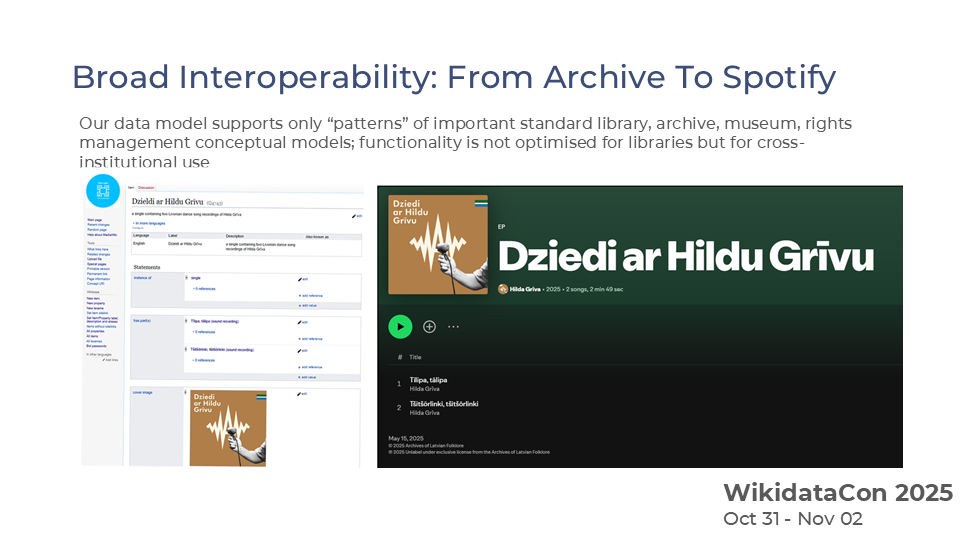
Aggregators such as Europeana can display the most restrictive licence, while research or educational users can act according to the specified use policy.
Summary
- GDPR compliance — screen linked agents, pseudonymise or anonymise where required.
- Simple case — one
use rightsURI per file, equivalent toedm:rights. - Composite case — multiple components, each with its own
use rightsanduse policy. - Interoperability — full equivalence with EDM, DCTERMS, and ODRL.
- Scalability — lightweight for images and texts, yet expressive for music and audiovisual works.
This model provides a sustainable bridge between cultural heritage and research data ecosystems, ensuring that digital twins can circulate legally and ethically within the European Collaborative Cloud for Cultural Heritage.
References
Annex
A1 AtoM - Wikibase Roundtrip
Archival Standards Relevant to AtoM and Wikibase
ISAD(G) and EAD (2002)
Access to Memory (AtoM) implements archival descriptions using the International Council on Archives’ legacy standards:
- ISAD(G): General International Standard for Archival Description
- ISAAR-CPF: Authority records for persons, families, and corporate bodies
These standards are serialised in:
- Encoded Archival Description (EAD 2002) for hierarchical finding aids
- Encoded Archival Context (EAC-CPF) for authority records
EAD 2002 is lightweight, stable, and easily parsed, but not graph-based.
Records in Contexts (RiC-CM / RiC-O 1.0)
In 2023, the ICA released:
- RiC-CM 1.0 (conceptual model)
- RiC-O 1.0 (ontology)
RiC supersedes ISAD(G), ISAAR-CPF, ISDIAH, and ISDF, providing richer, graph-based representations. It remains backwards-compatible with ISAD(G): every ISAD(G) element maps to an equivalent RiC construct.
Wikibase can implement RiC patterns naturally; AtoM cannot.
AtoM–Wikibase–AtoM Round-Trip: Core Principles
Ingest from AtoM
AtoM exports:
- EAD 2002 (archival descriptions)
- EAC-CPF (authority records)
These files contain hierarchical structure (c elements), identifiers (eadid, unitid), descriptive metadata (unittitle, physdesc, scopecontent), digital objects (dao), and names of creators or subjects.
Semantic Enrichment in Wikibase
Wikibase supports:
- reconciliation with VIAF, ISNI, ORCID, and national authority files
- multilingual labels and aliases
- linking archival descriptions to bibliographic, museum, linguistic, or geographic entities
- adding contextual information (events, functions, places)
- provenance and versioning
This step produces a richer graph-based representation than AtoM can store.
Export back to AtoM
Enriched records can be exported from Wikibase in simplified EAD 2002, containing:
- titles, identifiers, dates, extents
- parent–child hierarchy
- basic descriptive notes
- creators and subjects
- digital object references
Graph-rich RiC structures remain in Wikibase; AtoM receives an EAD profile it can ingest.
Incremental Ingestion into AtoM
AtoM supports:
- incremental import of individual EAD files
- adding to existing holdings without overwriting
- optional replacement when identifiers match
This enables targeted updates of fonds, series, items, and authority records.
Minimal Mapping: ISAD(G) → RiC → Wikibase → EAD (Round-Trip)
Hierarchy
| ISAD(G) | RiC Equivalent | Wikibase pattern | Back to AtoM (EAD) |
|---|---|---|---|
| Fonds | RiC-RecordSet | Item (instance of “fonds”) | <archdesc level="fonds"> |
| Series | RiC-RecordSet | Item (instance of “series”) | <c level="series"> |
| File | RiC-Record | Item (instance of “file”) | <c level="file"> |
| Item | RiC-Record | Item (instance of “item”) | <c level="item"> |
Identifiers
| ISAD(G) | RiC | Wikibase | Back to EAD |
|---|---|---|---|
| unitid | RiC-Identifier | Property “AtoM ID” | <unitid> |
| eadid | RiC-Identifier | Property “EAD ID” | <eadid> |
Agent Data
| AtoM (ISAAR-CPF) | RiC | Wikibase | Back to EAD/EAC-CPF |
|---|---|---|---|
| persname | RiC-Person | Item linked via “creator” | <origination> or EAC-CPF |
| corpname | RiC-CorporateBody | Item linked via “creator/agent” | <origination> |
Digital Objects
| AtoM (EAD) | RiC-DigitalObject | Wikibase | Back to EAD |
|---|---|---|---|
<dao> |
RiC-DigitalObject | Property “digital object URL” | <dao> |
Notes & Descriptions
| ISAD(G) element | RiC equivalent | Wikibase | Back to EAD |
|---|---|---|---|
| physdesc | RiC-Extent/Carrier | Property “extent/format” | <physdesc> |
| scopecontent | RiC-ContentType | Property “scope and content” | <scopecontent> |
Recommended Use Cases for HH
Migration and Cleaning of Legacy Databases
Legacy systems (spreadsheets, SQL dumps) can be transformed into Wikibase items, reconciled and enriched, then exported to EAD for stable long-term storage in AtoM.
Cross-domain Contextualisation
Wikibase links archival materials to:
- bibliographic entries
- museum objects
- geographic gazetteers
- linguistic or ethnographic datasets
- national heritage registries
AtoM receives only the ISAD(G)-compatible distilled output.
Practical Notes for HH
- AtoM remains the operational catalogue; Wikibase provides semantic enrichment.
- Round-trip EAD export ensures compatibility with existing workflows.
- RiC-based modelling in Wikibase can grow gradually.
- Incremental EAD import allows safe updates without reloading the entire archive.
Footnotes
The European Interoperability Framework (EIF) not only as a semantic guide but also as a legal and organizational model (Commission and Digital Services 2017; European Commission 2017) to connect various library, museum, archival, geographic information and other services.↩︎
ECCCH: (Commission et al. 2022; ECHOES Ontology Task Force 2025); CIDOC: (Bekiari et al. 2024), RiC (Archives Expert Group on Archival Description 2023), Dublin Core (DCTERMS): (Core 2020).↩︎